
ACT Science Practice Test 7: Mock Exam & Answer Key
Từ khoá: ACT Science Practice Test 7 luyện thi ACT đề thi ACT Science cấu trúc đề thi ACT ACT Science Mock Test tài liệu ôn thi ACT
Bộ sưu tập: Tuyển Tập Bộ Đề Thi Đại Học Hoa Kỳ (ACT) - Có Đáp Án Chi Tiết
Số câu hỏi: 24 câuSố mã đề: 1 đềThời gian: 1 giờ
The Citric cycle is an essential process used to transform carbohydrates, lipids, and proteins into energy in aerobic organisms. If yeast is unable to produce succinate, it cannot survive. The Citric cycle steps leading to the creation of succinate in yeast are shown in Figure 1. Each step in this cycle is catalyzed by an enzyme, which is essential to overcome the energy barrier between reactant and product. In the first step, Enzyme 1 is the enzyme, citrate is the reactant, and isocitrate is the product.
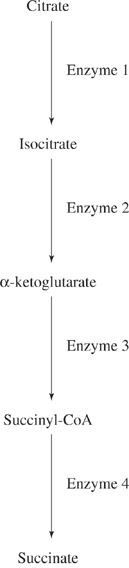
Figure 1
Experiment
A scientist grew four strains of yeast on several different growth media. Each strain was unable to produce succinate because it lacked one of the enzymes required for the reaction pathway shown in Figure 1. Table 1 shows the results of the scientist's experiment: "Yes" indicates that the strain was able to grow in the basic nutrition solution (BNS) + the particular chemical. An undamaged strain of yeast would be able to grow in the basic nutrition solution without any additional chemical. If a strain was able to grow in a given growth medium, then it was able to produce succinate from the additional chemical added to the basic nutrition solution.
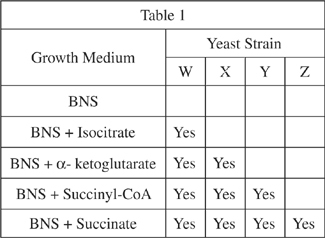
If certain genes are damaged, the essential enzymes cannot be produced, which means that the reactions that the enzyme catalyzes cannot go. Table 2 lists the genes responsible for the enzymes in the steps of the Citric cycle leading to succinate production in yeast. If an enzyme cannot be produced, then the product of the reaction that enzyme catalyzes cannot be synthesized and the reactant in that reaction will become highly concentrated. If a gene is damaged, then it is notated with a superscript negative sign, as in Cat3-; if a gene is not damaged it is notated with a superscript positive sign, as in Cat3+.
| Table 2 | |
| Gene | Enzyme |
| Cat1 | Enzyme 1 |
| Cat2 | Enzyme 2 |
| Cat3 | Enzyme 3 |
| Cat4 | Enzyme 4 |
According to the information in the passage and Table 2, a strain of yeast that is Cat1+ Cat2- Cat3- Cat4+ CANNOT produce:
One of the growth media shown in Table 1 was a control that the scientist used to demonstrate that all four strains of yeast had genetic damage that prevented the reactions shown in Figure 1, the reactions which are responsible for the synthesis of succinate. Which growth media was used as a control?
Many viruses are known to persist more prevalently during certain times of the year. A study of four relatively unknown viruses was conducted to examine their annual rate of prevalence and mortality in a host population. A large survey was conducted of local populations for the presence of antigen markers indicative of viral exposures to the four virus types. Measurements were acquired monthly beginning in January of 2000 and concluding two years later. All monthly measurements were averaged for comparison.
Figure 1 shows the incidence (cases per 1,000 individuals studied) of viral infections attributed to each viral type over the duration of the study. Figure 2 shows the number of deaths (per 1,000 individuals studied) attributed to virus A and D infections.
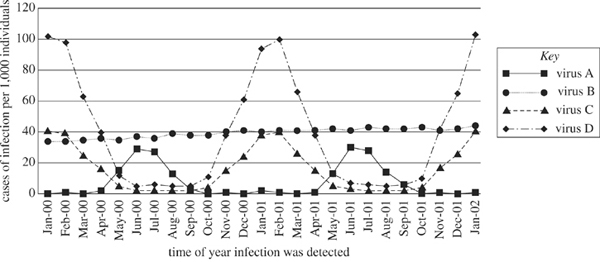
Figure 1
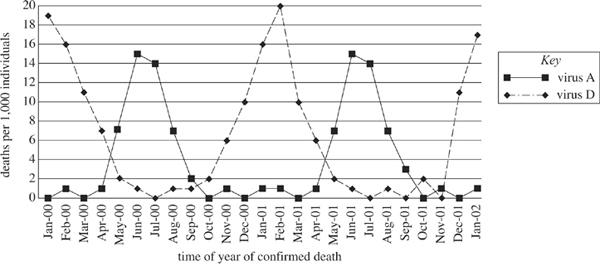
Figure 2
According to Figure 1, the incidence of virus A is greatest during which season of the year?
According to Figure 1, during April 2001, which virus was least prevalent in the studied population?
In a previous study, a virologist claimed that the incidence of virus B has always exceeded the incidence of virus C. As shown in Figure 1, the data for which of the following months is inconsistent with the virologist's claims?
According to Figure 1, the incidence of at least 3 of the viruses is most alike during which of the following months?
The pH at which a protein is uncharged is called its isoelectric point (pI). As the surrounding pH decreases, proteins gain an increasing positive charge. As the surrounding pH increases, proteins gain an increasingly negative charge. In gel electrophoresis, a mixture of proteins can be separated based on their relative charge. The proteins are first dissolved in a solvent and then placed at the starting point of an agarose gel. A current is applied to the gel and the proteins migrate different distances according to their charge (see Figure 1).
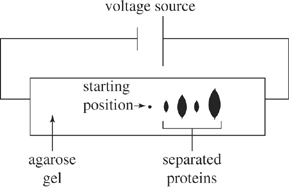
Figure 1
The following experiments were done to determine how varying the pH of a solvent affects the separation of proteins with gel electrophoresis. Table 1 shows the isoelectric points of the proteins and the pH values of the solvents used. The pH scale is logarithmic. Solutions with a pH less than 7.0 are acidic, while those with a pH more than 7.0 are basic.
| Table 1 | |
| Protein | pI |
| A B C D | 8.2 7.4 6.8 5.9 |
| Solvent | pH |
| 1 2 3 | 8.9 9.6 10.2 |
Experiment 1
A special paper 150 mm long is treated with an agarose gel. Electrodes were attached on each end and wired to a 100-volt source. A 150 μg mixture of proteins A-D was added to Solvent 1 to make a 200 μL solution. The solution was placed at the starting point of the gel and allowed to separate for 60 minutes. The density of the separated proteins was plotted as a percentage over their distance traveled. The procedure was repeated for Solvents 2 and 3 and the results presented in Figure 2.
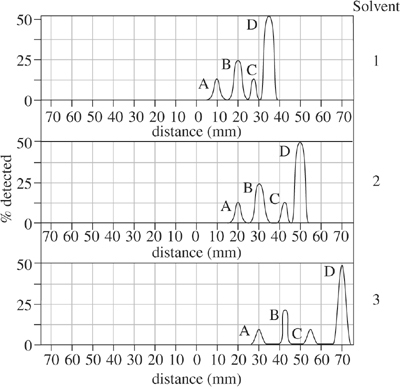
Figure 2
Experiment 2
The procedures of Experiment 1 were repeated after reversing the electrode attachments on the voltage source. Results are shown in Figure 3.
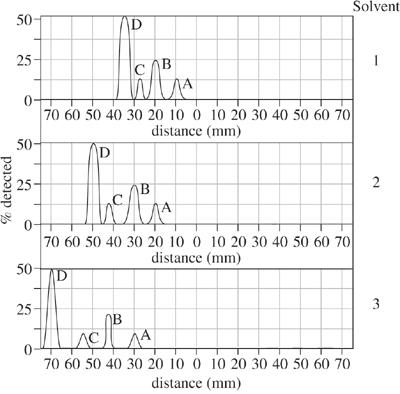
Figure 3
Protein L has an isoelectric point (pI) of 6.6. The results of Experiments 1 and 2 would be most similar to the plots shown in Figures 1 and 2 if, in each trial, Protein L were added to the protein mixture after removing:
The resolution of gel electrophoresis decreases as the overall distance between the peaks on the density plot decreases. Based on the results of Experiments 1 and 2, which of the following sets of conditions had the lowest resolution for the separation?
Experiment 1
Suppose that Experiment 1 will be repeated using Solvent 2, but Protein Y (pI = 7.1) is added to the overall mixture. Which of the following best predicts the order of migration distances of the 5 proteins, from shortest to longest?
Students studying gravity and motion were given the following information:
o Gravity is an attractive force between two bodies that is directly related to their mass and indirectly related to the square of the distance between their centers.
o Acceleration due to gravity is the acceleration of an object that results from the force of gravity.
o Weight is the force on an object that results from gravity, and is not the same as mass.
o Drag is a force directly related to the velocity of a moving object and which results from air resistance and acts to slow an object down.
o When the drag on a free falling object is equivalent to the weight of that object, the object maintains a constant velocity called terminal velocity.
The students' teacher then described the following experiment:
The experimenter dropped a ball from a known height and recorded the time it took to hit the ground. In a second location, a second ball was dropped from the same height and the experimenter observed that it took a longer time to fall to the ground.
Providing no additional information, the teacher asked her three students to provide an explanation of the experimental conditions that would account for the different times it took the two balls to fall.
Student 1
Both trials were conducted in air with the same atmospheric properties. The balls had the same mass and weight, but the second ball had a larger radius and surface area. Therefore, the second ball was subjected to more drag and reached a lower terminal velocity than the first. This resulted in an increased fall time.
Student 2
Each ball had identical dimensions, but the first ball was made of a denser material giving it both greater mass and weight. Each ball was dropped through air with the same atmospheric properties. Since the second ball was subjected to less gravitational force and weighed less, it reached a lower terminal velocity compared to the first. Therefore, the second ball took more time to hit the ground.
Student 3
Both balls had the same dimensions and mass. The first ball was dropped above the Earth, while the second ball was dropped above the Moon. The first ball reached terminal velocity in the Earth's atmosphere. The second ball was not subjected to any atmosphere or air resistance. However, there was substantially less gravitational force on the second ball and subsequently it weighed less than the first ball. The overall net result was that the second ball fell more slowly and took longer to hit the ground.
The teacher added another question to the students' assignment: Suppose the experimenter repeated the experiment by dropping two balls at the same time from the same height in a single vacuum, where no air resistance was present. The balls have different dimensions but identical weights, and they hit the ground at the same time. This new result is consistent with the explanations of which student(s)?
1 mã đề 23 câu hỏi
1 mã đề 22 câu hỏi
1 mã đề 13 câu hỏi
1 mã đề 25 câu hỏi
1 mã đề 20 câu hỏi